


.png)



New - Just Now





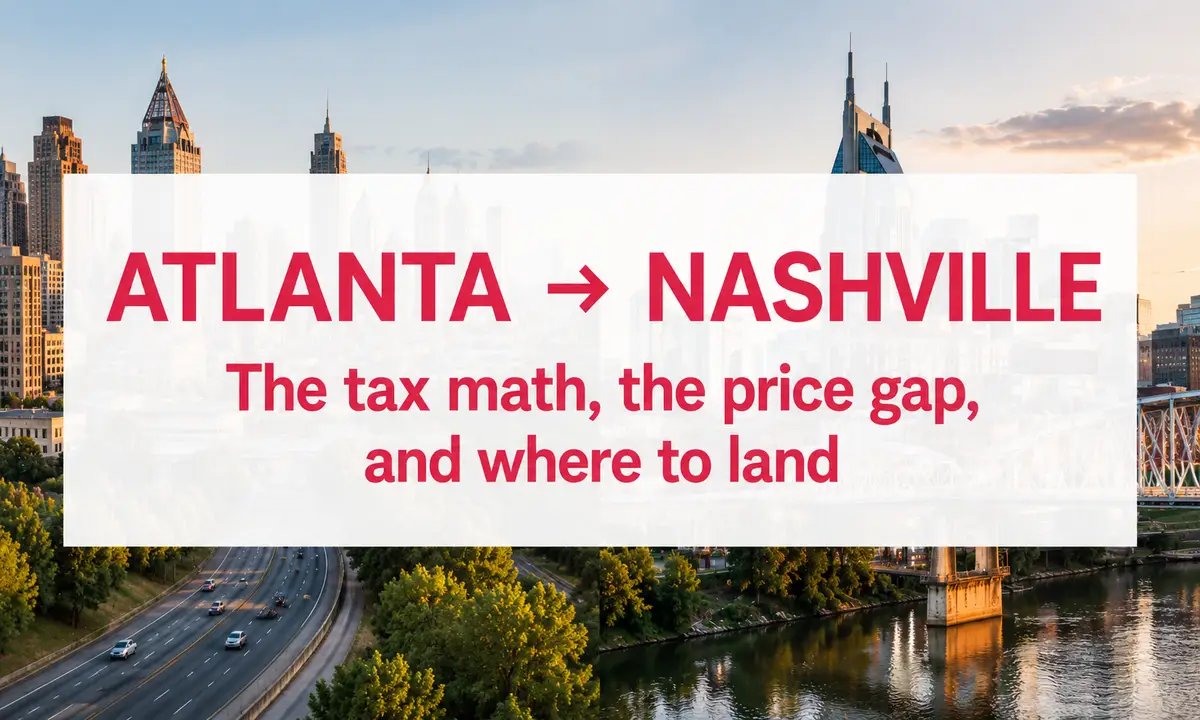
The tax math, the price gap, and where Atlanta buyers actually land in Middle Tennessee.
Georgia's flat income tax is 4.99% for 2026. Tennessee's is zero. On a $150,000 household income, that's roughly $7,500 a year back in your pocket — no job change required.
Georgia doesn't top the list of states sending new residents to Tennessee — California and Florida usually claim the first two spots — but it's rarely far behind. Recent migration data puts Georgia consistently among the top three to five origin states for Tennessee's inbound moves, and metro Atlanta accounts for most of that volume.
After 22 years and 500+ transactions, we've walked plenty of Atlanta families through this move, and it's a different conversation than the one we have with people leaving Chicago or Los Angeles. Georgia's taxes aren't nearly as painful as Illinois's. Atlanta already has walkable urban pockets, a blue city core surrounded by redder suburbs, and traffic that would make most cities blush. A lot of what people think they're moving to Nashville to find, they already have some version of at home.
So here's where the case for Nashville holds up — and where it's closer to a wash.
Start with income tax, since it's the biggest single number. Georgia has spent the last two years cutting its flat rate — 5.49% in 2024, 5.19% in 2025, and 4.99% for the 2026 tax year under House Bill 463. Tennessee's rate has been zero the entire time.
On a $150,000 household income, Georgia's 4.99% comes to roughly $7,500 a year in state tax. Tennessee takes none of it. Over a decade, that's a down payment, several years of tuition, or a real head start on a college fund.
Keep the context in mind, though: at 4.99%, Georgia isn't a high-tax state anymore. This isn't the same conversation we have with someone leaving Illinois or California. It's less about escaping a burden and more about keeping more of a paycheck you're already comfortable with.
Property taxes tell a similar, smaller-gap story. Georgia's statewide effective rate averages around 0.8%–0.9%, though it swings by county — Fulton runs higher, some exurban counties run lower. Tennessee's rates sit lower across the board: Davidson County (Nashville itself) runs around 0.55%, and Williamson County, home to Brentwood and Franklin, is closer to 0.34%. It adds up on a $600,000+ home, but it's not the dramatic gap Illinois transplants see.
Sales tax flips the script. Georgia's combined state and local rate averages around 7.5%. Tennessee's runs closer to 9.5%–9.75%, among the highest combined rates in the country. If you spend heavily on retail, dining, or big-ticket purchases, Tennessee costs you more here. It doesn't undo the income tax savings, but it's worth knowing before you assume Tennessee is cheaper on every line.
Nashville is not the obvious bargain it is for someone leaving Los Angeles or Chicago.
Nashville's citywide median home price has been running around $475,000. Metro Atlanta's median sits somewhere in the $400,000s, depending on which of its counties you're measuring — Fulton, Cobb, Gwinnett, and Forsyth all price very differently from one another. Depending on the specific comparison, the two markets can land within a few percentage points of each other, or Nashville can come in higher.
That doesn't make the move a bad idea. It means the financial case here is less "everything is cheaper" and more "we keep more of what we earn." Tennessee's broader cost-of-living index still runs a bit below Georgia's — but that gap comes from taxes, not housing.
Atlanta's job market is bigger and more diversified. Coca-Cola, Delta, Home Depot, and UPS are all headquartered there, and Georgia's film and TV production incentives have built out a creative economy Nashville doesn't have at the same scale. If you're moving without a job already lined up, Atlanta simply offers more doors.
Nashville's strengths run through healthcare, music and entertainment, and a growing wave of corporate relocations. A meaningful share of recent arrivals work remotely for companies based elsewhere — for them, this move is a straightforward arbitrage: keep an Atlanta-level paycheck, pay Tennessee's tax rate instead of Georgia's.
Atlanta's reputation for traffic is earned. Recent congestion data puts the average Atlanta driver losing around 75 hours a year to traffic — one of the higher totals in the country.
Nashville isn't the escape hatch it might look like from the outside. The same 2026 rankings put Nashville drivers losing around 65 hours a year — better than Atlanta, but not by the margin you'd hope for after moving somewhere smaller. I-24, I-40, and I-65 all bottleneck at the same predictable spots every afternoon.
The geography is different, at least — no Perimeter, no 285/400 interchange, no true inside-the-loop-versus-outside divide. But depending on which suburb you land in, your commute into downtown Nashville can run anywhere from 15 minutes to well over an hour at peak times. We break this down by county on our Nashville commute times guide.
Four suburbs come up most often in these conversations. Each draws a slightly different comparison to somewhere you already know.
Franklin is the closest match to Alpharetta or Milton — a polished historic downtown, strong schools split between Williamson County Schools and the Franklin Special School District, and a lot of newer construction on the edges of town. Expect real competition for anything well-located. Read the Franklin guide → · View Franklin homes →
Brentwood is the premium option — bigger lots, more privacy, and some of the highest-performing schools in the state. It's a long-term ownership market, not a starter-home market.
Read the Brentwood guide → · View Brentwood homes →
Nolensville is the growth story — think Woodstock or Holly Springs north of Atlanta. It's added a lot of new subdivisions over the last several years while keeping its small-town downtown intact.
Read the Nolensville guide → · View Nolensville homes →
Murfreesboro is the value play — more house for the money, a genuine college-town feel around MTSU, and a self-sufficient community that doesn't lean on Nashville for everything. It's also the longest commute of the four, so it works best if you're not driving downtown daily. Read the Murfreesboro guide → · View Murfreesboro homes →
Not every Atlanta transplant wants a suburb. If you're used to Old Fourth Ward, Inman Park, or Virginia-Highland, Nashville has a few in-town neighborhoods built around the same idea — dinner and shopping a few minutes from your front door, no HOA, more personality than square footage. East Nashville has the creative, slightly scrappy energy. 12 South leans polished and boutique-heavy. Germantown mixes historic rowhouses with some of the city's best restaurants.
If you've ever had to double-check whether a Sandy Springs or Johns Creek address feeds into a specific Fulton County school or a separate city district, you already understand how this works. Middle Tennessee has its own version of that fragmentation. Brentwood's 37027 spans Williamson County Schools and Metro Nashville Public Schools — two very different school experiences at the same ZIP code. Nolensville's 37135 splits three ways. Old Hickory's 37138 splits between Davidson and Wilson counties. The rule here is the same one you likely already follow in Atlanta: verify by address, never by ZIP code alone. Our Nashville schools guide walks through it by area.
One thing that won't feel foreign: Middle Tennessee has the same urban-core-blue, surrounding-counties-red pattern that metro Atlanta has. If you're coming from inside the Perimeter, Davidson County — Nashville proper — will feel the most familiar politically. If you're coming from Cobb, Gwinnett, or Forsyth, the surrounding counties will read a lot like home.
Not dramatically, and not the way people expect. Nashville's home prices currently run close to or above metro Atlanta's, depending on which counties you compare. The real savings show up in Tennessee's zero income tax, not in a lower cost of living across the board.
At Georgia's current 4.99% flat rate, a household earning $150,000 saves roughly $7,500 a year in state income tax alone by moving to Tennessee. Georgia's rate has been falling steadily too, so the exact gap narrows a bit each year Georgia's cuts continue.
Franklin is the closest comparison — historic downtown, strong schools, plenty of newer construction on the edges. Brentwood is the pricier, lower-density version of the same idea.
Mostly, yes. Nashville's public transit is more limited than MARTA, and outside a handful of in-town neighborhoods, a car is standard. East Nashville, 12 South, and Germantown are the exceptions, where dinner and shopping are a short distance from most front doors.
A little, on average — but not enough to notice day to day. Plan your commute around a specific suburb and highway, not around an assumption that Nashville is less congested overall.
We've helped Atlanta families make this move before, and James does video walkthroughs for buyers who want to see a home before booking a flight. If you're starting to look seriously, or just want someone to talk through the tax math with, we're a call away.
Franklin Neighborhood Guide
Brentwood Neighborhood Guide
Nolensville Neighborhood Guide
Murfreesboro Neighborhood Guide
Full Nashville Neighborhoods Guide
Nashville Commute Times by County
Best Schools in Nashville: A Moving Guide
Related: Moving from Chicago to Nashville
.png)
James and Stephanie Crawford have been buying and selling homes across Middle Tennessee since 2003 — 500+ transactions and counting. James handles showings and video walkthroughs for out-of-state buyers; Stephanie manages strategy, contracts, and negotiation from home. No assistants, no hand-offs. When you work with them, you work with them directly.
.png)
People don’t move to Nashville looking for “the best neighborhood.” They move looking for the right fit—for their commute, their budget, their stage of life, and how they actually live day to day.This guide reflects how buyers are choosing neighborhoods in 2026, not 2016. We’ll cover city neighborhoods and suburbs, what’s changed in the last few years, and which areas consistently rise to the top

School districts remain one of the primary drivers of real estate value in Middle Tennessee. As we move through 2026, the conversation has shifted from just "test scores" to "long-term stability." With Nashville’s rapid growth, school boundaries are shifting, and new campuses are opening to keep pace with the population boom.As Nashville natives and Realtors with over 20 years of experience, we h

Should you wait for interest rates to drop before buying a home in Nashville?Waiting for lower rates sounds logical, but in Nashville’s market, delaying often means higher prices, more competition, and fewer choices — which can outweigh the benefit of a slightly lower rate.If you’re asking this question, you’re not casually browsing. You’re already thinking seriously about buying — you’re just tr

Here's a stat that surprises people: more newcomers to Tennessee now come from Illinois than from California. Illinois accounts for roughly 21% of the state's inbound migration — the largest share of any state — and the bulk of those movers are leaving the Chicago area for Middle Tennessee.After 22 years and 500+ transactions, we've helped a lot of Chicago families make this move. Some of it goes