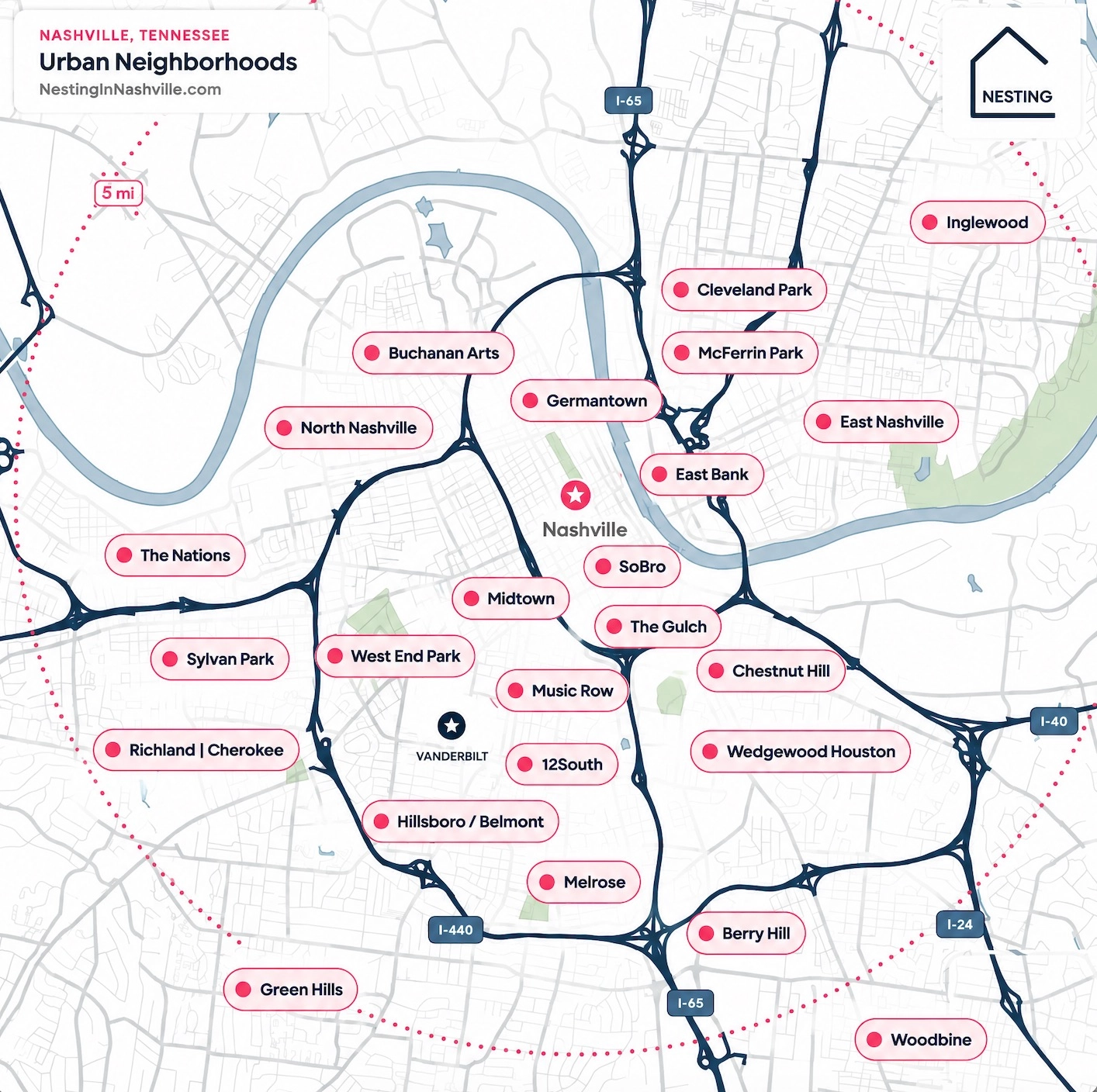
Tap or click the map to open Nashville Intown Neighborhoodis to full size.
This map shows 24 Nashville neighborhoods within about five miles of downtown, the part of the city most people mean when they say they want to live in town. Most sit inside the I-440 loop or right along it. Inglewood, Green Hills and Woodbine land just past the five-mile line, close enough that most in-town buyers look at them too.
We're Nashville natives and have been selling homes here since 2003, so we've watched most of these neighborhoods change block by block. Whether you're moving to Nashville for work or buying your first place in the city, this guide covers what each area is like to live in, what's for sale there, and what to check before you buy.
Beyond the nine neighborhoods we cover below, the map also shows:
- North: North Nashville, Buchanan Arts
- East of the river: East Bank, McFerrin Park, Cleveland Park, Inglewood
- West: The Nations, Richland | Cherokee, West End Park
- South: Chestnut Hill, Wedgewood Houston, Hillsboro / Belmont, Melrose, Berry Hill, Green Hills, Woodbine
What Makes Nashville's Urban Core Special
Nashville's core stays busy after the office towers empty out. Broadway, the Ryman and Bridgestone Arena fill the evenings downtown, and the neighborhoods around it have main streets of their own: Jefferson Street in North Nashville, 12th Avenue South, Charlotte Avenue on the west side, and Five Points in East Nashville. Housing is mostly condos, townhomes, HPRs and older houses on small lots.
Before you fall for a condo, read the HOA budget and reserve study. A thin reserve fund is where special assessments come from, and those can run thousands of dollars per unit.
Nashville's Core Urban Neighborhoods
Downtown Nashville — Condo Towers and Converted Lofts
Downtown housing is almost all condos: high-rise towers, a few mid-rise buildings, and older warehouses converted into lofts. You give up square footage for location. From most downtown buildings you can walk to Bridgestone Arena, the Ryman, the Frist Art Museum and the main library on Church Street.
Nashville Yards, on the west side of downtown next to Union Station, has added offices, hotels, restaurants and a concert venue within a few blocks of the downtown condo towers.
The Gulch — High-Rises on Old Rail Yards
The Gulch takes its name from the low ground between downtown and Music Row where the rail yards serving Union Station once ran. Today it's condo and apartment towers along 11th and 12th Avenues South, with restaurants and shops at street level. It's one of the densest neighborhoods in the city and one of the easiest places in Nashville to run errands on foot.
A good fit for buyers who want a lock-and-leave condo between downtown and Vanderbilt. More in our Gulch neighborhood guide.
SoBro — South of Broadway, Around Music City Center
SoBro covers the blocks south of Broadway between the river and the Gulch, home to Music City Center, the Country Music Hall of Fame and the Schermerhorn Symphony Center. Housing is mostly condo towers, with a few converted older buildings near Rutledge Hill. Convention traffic shapes the blocks closest to Music City Center, so pay attention to which side of a building a unit faces.
Midtown — Between Downtown and Vanderbilt
Midtown runs along West End Avenue and Broadway from the edge of downtown to Vanderbilt. It's mostly condos and apartments, with Vanderbilt University Medical Center, Centennial Park and its full-scale Parthenon replica, and the restaurants and music venues on Elliston Place all close by. That puts a lot of Vanderbilt staff, medical residents and Music Row professionals in the buyer pool.
Germantown — Victorian Homes North of the Capitol
Germantown was settled by German immigrants in the mid-1800s, which makes it one of Nashville's oldest neighborhoods. Restored Victorian and Italianate homes share the blocks with newer townhomes and condo buildings. The Nashville Farmers' Market, Bicentennial Capitol Mall State Park and First Horizon Park, home of the Nashville Sounds, sit along the neighborhood's southern edge. More in our Germantown neighborhood guide.
12 South — Bungalows and Shops on 12th Avenue South
12 South is the commercial stretch of 12th Avenue South running down to Sevier Park, plus the residential streets on either side. The housing is early-1900s bungalows mixed with a lot of tall, narrow new construction where older homes came down. Boutiques, coffee shops and restaurants line 12th, and the "I Believe in Nashville" mural is here too. More in our 12 South neighborhood guide.
Music Row — Studios, Labels and Edgehill
Music Row is the cluster of recording studios, publishers and label offices along 16th and 17th Avenues South, also called Music Square East and West. Many of those offices are converted houses, and RCA Studio B, where Elvis and Dolly Parton recorded, is on the Row. There's little housing on the Row itself, so most buyers here end up in the condos and townhomes nearby or in the adjoining Edgehill neighborhood.
East Nashville — Across the River from Downtown
East Nashville covers a lot of ground. Edgefield and Lockeland Springs, closest to the river, carry the oldest housing stock: Victorian and craftsman homes, some on lots that have since been split into two new HPR homes. Five Points is the commercial center, and Shelby Park and Shelby Bottoms run along the river on the east side. More in our East Nashville neighborhood guide.
The East Bank, the riverfront directly across from downtown where the new Titans stadium is going up, is a separate redevelopment area and gets its own label on the map.
Sylvan Park — State-Named Streets on the West Side
Sylvan Park sits between Charlotte Avenue and Murphy Road, about four miles west of downtown. Many of its avenues are named after states (Nevada, Utah, Colorado), and the housing is a mix of early-1900s cottages and bungalows alongside newer builds. McCabe Park and its public golf course sit on the west side, and The Nations is just north across Charlotte. More in our Sylvan Park neighborhood guide.
Urban Living: What to Expect
Transportation & Walkability
Living in town shortens your drives more than it replaces them. You can walk to dinner from the Gulch, Germantown or 12 South, and WeGo buses run through most of these neighborhoods, but Nashville is still a car city and most of our in-town buyers keep at least one car. I-40, I-65, I-24 and I-440 all pass through or around this five-mile ring, so most of these neighborhoods are a few minutes from an on-ramp. Compare commute times by county.
Amenities & Lifestyle
The Country Music Hall of Fame, the Ryman, the Frist Art Museum and the Schermerhorn Symphony Center are all downtown, and Vanderbilt and Belmont add concerts, lectures and games on the west side. Many condo buildings have a gym, pool or rooftop deck. Those are paid for through your HOA dues, so count them in the monthly cost.
Buying Urban: Insider Knowledge
Property Types Explained
Condos: You own your unit and a share of the common areas. The HOA maintains the building, grounds and shared systems.
Lofts: Condos in converted warehouses and commercial buildings, usually with high ceilings, exposed brick and open layouts.
High-rises: Towers in downtown, the Gulch, SoBro and Midtown. Views and building amenities typically come with the highest HOA dues.
HPRs: Two or more homes on one lot under a horizontal property regime, common in East Nashville, 12 South, Sylvan Park and The Nations. They look like single-family homes but share a regime, and sometimes shared costs. How HPRs work in Nashville.
Important Considerations
- Financing: Lenders review the building as well as you. A building with heavy investor ownership, a thin reserve fund or pending litigation can rule out FHA, VA or conventional loans.
- Insurance: Condo owners need an HO-6 policy for the interior. Read what the building's master policy covers before you price it.
- Parking: Some buildings deed a space with the unit. Others sell or lease spaces separately.
- Rentals: Many buildings cap or ban rentals, and short-term rentals also need a Metro permit. Check both before you buy with rental plans.
- Noise: Units facing Broadway, a busy Gulch corner or a rooftop bar will hear it on weekends.
Because the lender has to approve the building as well as the buyer, condo loans have more moving parts than single-family loans. Our go-to lender for in-town purchases is Mary Littleton with Accurate Mortgage, who can tell you early whether a building you like will work with your loan type.
Is Urban Nashville Right for You?
Urban living works if you:
- Want to walk to dinner, a park or a show
- Are fine sharing a wall or a lot line
- Want short drives to downtown, Vanderbilt or Music Row
Consider alternatives if you:
- Need a fenced yard for kids or a dog
- Want the most square footage for your budget
- Prefer quiet evenings
- Plan big renovations, which condo bylaws often limit
Ready to Explore Urban Nashville?
Tell us the two or three neighborhoods you're weighing and what matters most, whether that's commute, budget, a yard or low HOA dues, and we'll tell you what we see there. We've helped hundreds of buyers into in-town homes, so we know which buildings are well run and which streets get morning sun.
James tours with you in person. Stephanie handles strategy, contracts and negotiation. No hand-offs to assistants.
Want more space? See our guide to Nashville's suburban neighborhoods.

James & Stephanie Crawford are Nashville natives who have helped buyers and sellers since 2003, with more than 500 sales. As owners of Nesting Realty, they work directly with every client, start to finish. Call (615) 751-8913 or email [email protected].